


Blog
Why Your Chair Is Ruining Your Sleep
Quick Answer
Yes, a poorly fitted office chair can disrupt your sleep. Hours of unsupported sitting build muscle tension, keep cortisol elevated into the evening, and let musculoskeletal pain surface once you lie down. All three delay sleep onset and pull you out of deep, restorative sleep. Correcting chair fit is one of the fastest ways to improve morning stiffness and sleep quality.
You have probably spent real time thinking about your sleep.
Maybe you have a consistent bedtime, a wind-down routine, blackout curtains, and a good mattress you researched carefully before buying. You have taken sleep seriously because you understand that recovery is not optional. It is the thing that makes everything else possible.
And yet you still wake up stiff. You still carry a dull tension between your shoulder blades by mid-morning. You still feel like your body has not fully reset, no matter how many hours you logged the night before.
Here is the part almost nobody considers: what happens at your desk during the day directly determines how well your body is able to recover at night. Your chair and your sleep are not separate subjects. They are part of the same system, and if one is broken, the other cannot fully do its job.
What Is Your Body Actually Doing While You Sleep?
Sleep is not passive. It is your body’s primary maintenance window.
During deep sleep, your muscles release the tension they have accumulated during the day. Your intervertebral discs, the shock-absorbing pads between each vertebra of your spine, rehydrate. This is measurable: MRI scans taken on the same people morning and evening show the lumbar spine loses roughly 2 percent of its height over a day of normal loading, and disc volume in the lower lumbar spine drops by an average of 16 percent across a working day. Overnight, fluid flows back in and the discs recover. The inflammatory responses triggered by the day’s physical stresses begin to resolve. Your nervous system downregulates from whatever state of activation it has been holding.
This process works well when the physical load your body carries into the night is within a normal, manageable range.
It works less well when that load is significantly elevated, when your muscles have been holding compensatory tension for eight hours, when your spine has been in a non-neutral position for most of the day, and when your nervous system has been quietly managing a sustained postural stress response since 9 a.m.
In those conditions, your body arrives at sleep with a repair backlog it cannot fully clear in the hours available. You wake up feeling like something is still unresolved, because something is.
How Does a Bad Chair Disrupt Your Sleep?
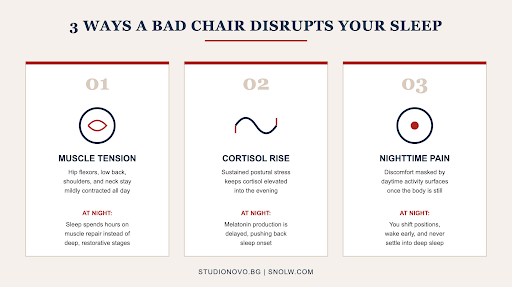
Muscle Tension That Does Not Release
When your chair does not support your spine correctly, specific muscle groups, most commonly the hip flexors, the lumbar erectors, the upper trapezius, and the suboccipital muscles at the base of the skull, stay in a state of low-level contraction throughout the day to hold you upright.
These muscles are not designed for sustained static work. Occupational health researchers call this the Cinderella hypothesis: during low-effort static tasks, the smallest motor units are recruited first and released last, so the same fibers stay switched on for the entire working session. EMG studies of computer work have confirmed motor units that remain continuously active throughout the task, which is how work that feels physically easy still produces real tissue fatigue.
By the end of the day these muscles are fatigued, shortened, and often mildly inflamed. That inflammation and tension does not vanish the moment you get into bed. It takes time to resolve, more time than a standard sleep cycle easily provides.
The result: you fall asleep, but your body spends a disproportionate amount of the night managing muscular recovery rather than progressing through the deeper, more restorative stages of sleep. You wake up technically rested but physically unrefreshed.
Cortisol Dysregulation
Your body’s cortisol levels follow a natural rhythm across the day, peaking in the morning to support alertness and tapering off toward evening to allow sleep to begin. This rhythm is partly governed by your physical state.
Sustained postural stress, the kind generated by hours in a chair that does not fit your body, keeps your cortisol levels elevated above where they would naturally sit in the afternoon and early evening. Sleep researchers have documented that cortisol and sleep interact in both directions: sleep onset suppresses cortisol secretion, while elevated evening cortisol is associated with more fragmented sleep and more time awake after falling asleep. Separately, higher accumulated sedentary time has been linked to a flatter daily cortisol curve, meaning levels that fail to taper properly toward evening. The evidence connecting a specific chair to a specific cortisol reading does not exist yet, but the pattern is consistent: a physically demanding, static day tends to leave you more activated in the evening than a well-supported one.
Your body’s readiness for sleep is pushed back. You feel alert when you want to feel drowsy, or you fall asleep easily but wake in the early hours and cannot return to sleep, a pattern many people attribute to stress or anxiety that is, at least in part, a physiological response to their physical environment.
Pain That Surfaces at Night
This is perhaps the most direct mechanism, and the best evidenced. A systematic review and meta-analysis in Rheumatology found that people with chronic musculoskeletal pain had roughly twice the incidence of new sleep problems compared with people without it. A later meta-analysis in PAIN found the relationship runs both ways, with sleep problems also raising the risk of developing chronic musculoskeletal pain. Pain and poor sleep feed each other.
Musculoskeletal discomfort that is easy to ignore during the day, because you are distracted, moving, or occupied, often becomes the dominant sensation at night when everything else quiets down.
Lower back pain, hip tightness, neck stiffness, and shoulder tension that registered as mild background noise during working hours can become genuinely sleep-disrupting at night. You shift positions looking for relief. You wake early. You never fully settle into the deep sleep stages where the most valuable recovery occurs.
The pain is real, but its source is not the night. It is the preceding eight hours.
What Does the Research Say About Sitting Posture and Sleep Quality?
The connection between daytime posture and sleep quality is increasingly well documented.
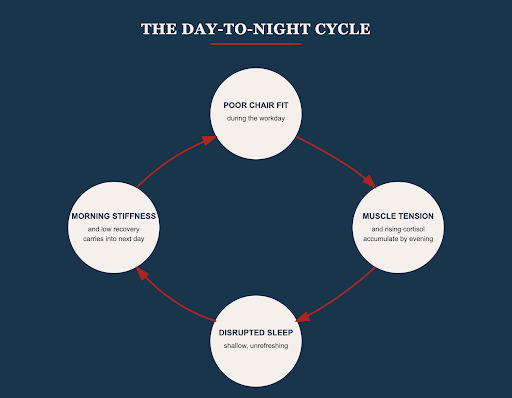
Ergonomic intervention trials point the same direction. A randomized controlled trial in automotive workers with chronic low back pain found that ergonomics training combined with exercise improved pain, functional capacity, and sleep quality more than the control condition. A separate randomized trial in textile workers with neck pain measured sleep quality alongside pain and found significant improvement in both. Sleep quality is not a side note in this research. It is one of the outcomes that moves.
Your chair affects your sleep not as a metaphor but as a biological mechanism.
What Specifically Should You Address?
The Hip Flexor Problem
Sitting for extended periods keeps your hip flexors in a shortened position. This is not just theory: a cross-sectional study of sitting and hip mobility found that people who sat for long periods and were physically inactive had measurably reduced passive hip extension compared with more active groups. Restricted hip extension changes how the pelvis sits, which in turn changes the load on the lumbar spine. Tight hip flexors alter the anterior tilt of your pelvis in a supine position, which increases the lumbar curve and loads the lower back even while you sleep.
If you frequently wake with lower back discomfort that eases after you have been moving for thirty minutes, shortened hip flexors are a likely contributor, and the primary cause is how you have been sitting during the day.
A chair with a seat pan that allows a slight anterior pelvic tilt and adequate seat depth keeps the hip flexors in a more natural length throughout the day. This alone can meaningfully reduce the lower back tension you carry into the night.
The Neck and Upper Back Loading
Forward head posture, extremely common in home office environments where screens sit too low, creates a sustained load on the levator scapulae, upper trapezius, and suboccipital muscles. A review of forward head posture and chronic neck pain describes the pattern clearly: the muscles at the back and side of the neck shorten and tighten while the deep neck flexors lengthen and weaken, a combination associated with neck pain, tension headaches, and trigger points in the suboccipital muscles. These muscles are densely connected to the autonomic nervous system. Chronic tension in this region has a direct relationship with sympathetic nervous system activation, the physiological state that keeps you alert, ready to respond, and resistant to sleep.
Correcting monitor height and using a chair with a headrest or well-positioned upper back support significantly reduces this tension load. The downstream effect on sleep onset and quality is, for many people, one of the most immediately noticeable benefits of getting their workspace right.
The Overall Nervous System Load
Your nervous system does not clearly distinguish between the stress of a difficult conversation and the stress of holding a non-neutral posture for eight hours. Both register as demands. Both require recovery.
When your workspace is correctly configured, when your chair, desk, and monitor are calibrated to your body and your body is not working against its environment all day, you arrive at the evening with a significantly lower accumulated physiological load. Sleep can do what it is designed to do. Recovery is complete rather than partial.
You notice the difference not in dramatic terms but in quiet ones. You wake without the stiffness. You feel genuinely refreshed rather than approximately rested. The difference between the two is significant, and for many people, it begins with a chair.
Why the Evening Transition Matters Too
One additional factor worth noting: the transition between your workday and your evening is partly governed by your physical state as you close the laptop.
When you finish work carrying significant muscular tension and an elevated cortisol load, the transition to rest is slow. Your body needs time to downregulate before sleep becomes truly accessible. This is why many people find themselves unable to sleep even when they are tired: the nervous system is still in a state of activation it cannot quickly exit.
A correctly configured workspace reduces the activation level you carry out of your working hours. Combined with deliberate movement at the end of the day, such as a short walk or some light stretching, this can meaningfully improve both the speed of sleep onset and the depth of early sleep cycles.
The investment in your workspace, in other words, pays dividends not just during working hours but in every hour that follows.
Frequently Asked Questions
1. Can a bad office chair really affect how well I sleep?
Yes, through several direct mechanisms. Poor chair ergonomics creates sustained muscular tension and elevated cortisol levels that persist into the evening, both of which disrupt sleep onset and sleep quality. The connection is physiological, not coincidental, and shows up consistently in ergonomic intervention studies.
2. I sleep well but wake up stiff every morning. Could my chair be responsible?
Yes, this is common. Morning stiffness that resolves with movement is often related to muscular tension and reduced spinal disc hydration caused by extended sitting in a poor position. Your body may be technically asleep but spending more recovery capacity managing daytime physical stress than progressing through restorative deep sleep.
3. What chair features matter most for reducing the physical load I carry into the night?
A chair that supports the natural curve of your lower back, seat depth that does not compress the back of your knees, and seat height that allows a neutral pelvic position are the three most impactful features. A chair that allows dynamic movement throughout the day beats one that locks you into a fixed posture, and this is one of the better-evidenced claims in ergonomics. In a six-month cluster-randomized trial of 133 high-risk office workers, the group given a seat cushion that encouraged small postural shifts had a 10 percent incidence of new low back pain against 59 percent in the control group, and 15 percent for neck pain against 65 percent.
4. Should I do anything in the evening to help the transition to sleep?
A short walk, gentle movement, or light stretching at the end of the workday helps signal to your nervous system that the active phase is over. This is especially effective after long static sitting, since movement clears accumulated muscle tension and begins the cortisol tapering that sleep requires.
5. How quickly would I notice a sleep improvement if I fixed my workspace setup?
Most people who make meaningful ergonomic improvements, particularly to chair fit and monitor position, notice changes in morning stiffness and sleep quality within one to two weeks. The timeline varies depending on how significant the previous issues were and how consistently the corrected setup is used.
Your workspace and your recovery are part of the same system. If one is not working, the other cannot fully work either. Explore our range of ergonomic seating and home office solutions at snolw.com, or visit our Sofia showroom to find the setup that fits your body.
📞 Contact: +359 882 282 663
🏢 Showroom: XS Tower, Ground Floor, 5 Panorama Sofia Street, Sofia 1766
🌐 Online: snolw.com
Blog
The Truth About Workplace Ergonomics: 3 Expensive Myths You Need to Stop Believing
And why “I’ll fix it eventually” is costing you more than you think. You know the setup. A chair dragged in from the dining room…
Hybrid Work Doubled Your Ergonomic Problems
Two workspaces. Two sets of problems. One body absorbing all of it. When hybrid work became the new…
The ‘Good Enough’ Trap: Why People Settle for Bad Home Office Furniture
And why “I’ll fix it eventually” is costing you more than you think. You know the setup. A chair dragged in from the dining room…