

Blog
The ‘Good Enough’ Trap: Why People Settle for Bad Home Office Furniture
And why “I’ll fix it eventually” is costing you more than you think.
You know the setup. A chair dragged in from the dining room. A laptop balanced on whatever surface was available in 2020. A monitor, if there is one, sitting directly on the desk at a height that made sense at the time and has never been questioned since.
It is not a disaster. It works. You get through the day.
That is exactly the problem.
How You Got Here
Nobody chose a bad home office. It happened incrementally.
In early 2020, remote work arrived fast and with no warning. You grabbed a chair, cleared a corner, and made it work because you had to. That was reasonable. That was survival.
Then the weeks became months. The months became years. And the temporary setup became permanent, not by decision, but by inertia. The friction of changing it always slightly outweighed the friction of tolerating it. So you tolerated it.
This is how most home offices in Bulgaria came to exist: not designed, but accumulated. And the longer they stay that way, the harder they become to question, because at some point, the discomfort becomes background noise. Your body stopped flagging it as new information.
The Rationalizations That Keep You Stuck
The “good enough” trap has a specific vocabulary. You have probably said at least one of these.
“I’m only home two or three days a week.” Two or three days a week is 40–60% of your working hours. That is not an occasional use case. That is a permanent environment that has never been treated as one. If you spent 40% of your time in a car with a broken seat, you would fix the seat.
“I’ll sort it out when we move / renovate / things calm down.” Things do not calm down. The move gets delayed. The renovation expands. “When things calm down” is not a date on a calendar; it is a condition that never fully arrives. The setup waits. The damage does not.
“It doesn’t really bother me.” This one is the most dangerous, because it feels true. Ergonomic damage is cumulative and slow. The neck stiffness that is manageable on Monday is chronic by year three. The lower back that “acts up occasionally” becomes something a physiotherapist is treating twice a month. The human body is very good at adapting to poor conditions; until it isn’t, and by then the problem is much harder and more expensive to reverse.
“Good chairs are too expensive.” Relative to what? A quality ergonomic chair costs somewhere between €400 and €900. A course of physiotherapy in Sofia runs €40–60 per session. Persistent musculoskeletal problems require many sessions, often over many months. The chair pays for itself faster than most people expect, and it does so while you work rather than while you recover.
What “Good Enough” Is Actually Costing You
The costs of a poor home office setup are real, but they are distributed across time in a way that makes them easy to ignore.
Physical cost. Musculoskeletal disorders are the most common work-related health complaint across the EU. Lower back pain, neck pain, shoulder tension, and wrist problems are all directly linked to poor workstation setup. They are also progressive, meaning the longer the bad setup continues, the harder the condition becomes to resolve.
Cognitive cost. Discomfort is not just physical. When your body is managing pain signals, even low-level, background ones, your brain is spending resources on that instead of your work. You cannot concentrate your way out of a chair that is fighting you. Numerous studies link ergonomic discomfort with reduced focus, increased error rates, and lower sustained output across the working day.
Financial cost. Beyond physiotherapy, there is lost productivity, sick days, and for freelancers and business owners, the direct cost of working slower and less well than they otherwise would. These numbers are hard to measure, which is exactly why they go unmeasured. But they are real.
Why We Keep Choosing Inertia
Understanding the psychology helps.
The pain is not acute enough to force action. Ergonomic damage rarely announces itself dramatically. It seeps in gradually, which means there is rarely a clear moment where the cost of staying becomes obviously greater than the cost of changing. You are always just below the threshold that triggers a decision.
The investment feels optional. Office furniture for a company feels like a business necessity. Furniture for your home office feels like a personal splurge, even if you are using it professionally, for the same number of hours, doing the same work. The framing of “home” makes it feel discretionary.
You compare it to the wrong baseline. The question most people ask is: “Is this bad enough to change?” The better question is: “What would genuinely good actually feel like?” Most people have never sat in a properly configured ergonomic chair for a full working day. They do not know what they are missing, which makes it very hard to feel the gap.
What Actually Breaks the Pattern
People who escape the good enough trap usually do so for one of three reasons.
A health event forces the issue; a physiotherapist tells them directly that their setup is causing the problem they came to treat. This is the most common trigger, and the most expensive one.
They try something better, a friend’s setup, a hotel business center, a well-fitted office, and feel the difference viscerally. Once you have worked a full day in a chair that actually fits you, the gap becomes impossible to unsee.
They reframe the investment, from “spending money on furniture” to “investing in the place where they produce their income.” For anyone who works from home regularly, this reframe is simply accurate. Your home office is a professional asset. It deserves to be treated like one.
Where to Start
The good news is that escaping the good enough trap does not require doing everything at once.
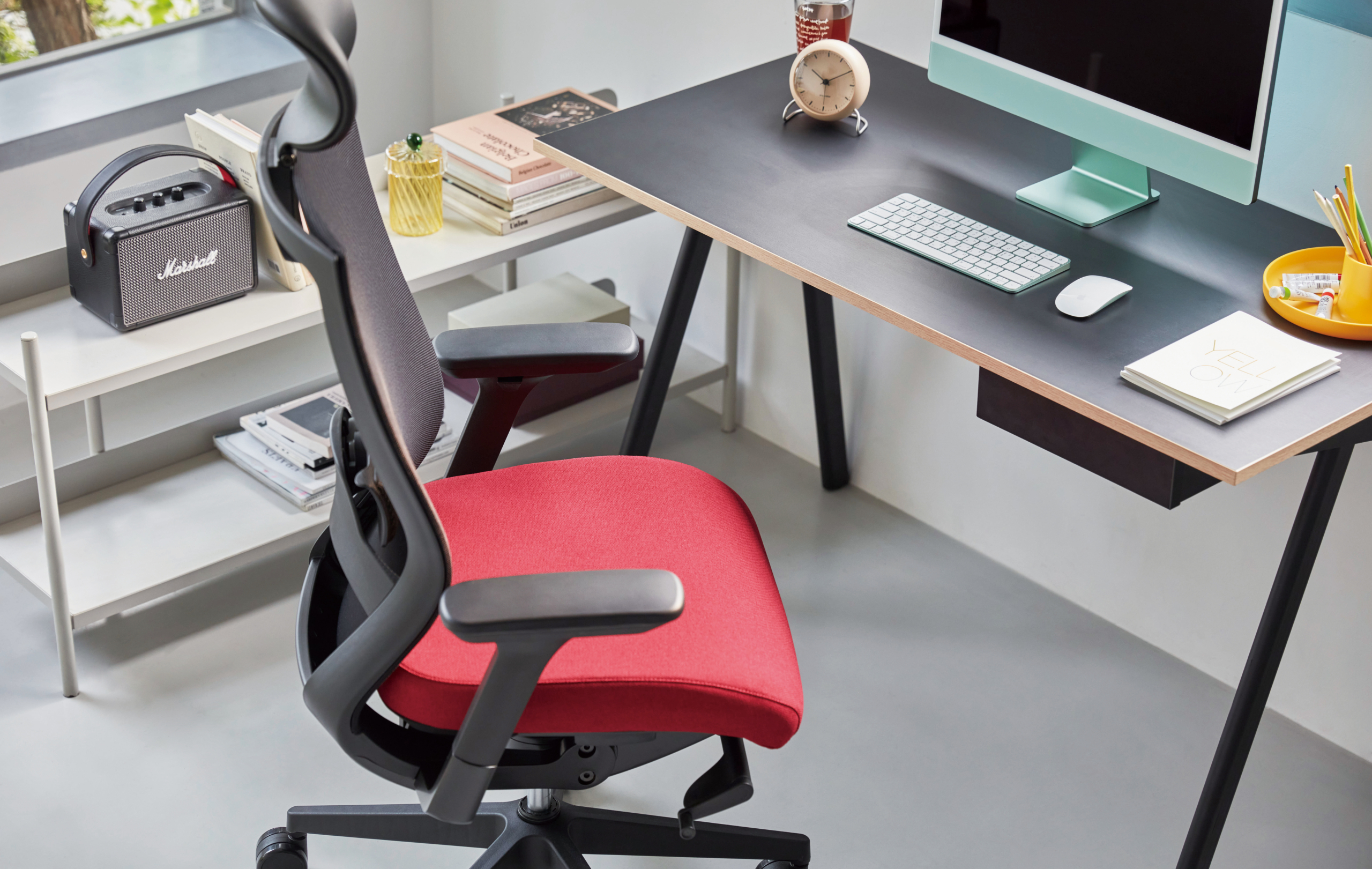
Start with your chair. It is the single highest-impact change available. A chair with adjustable lumbar support, seat height, and armrests, properly configured to your body, transforms the ergonomic baseline of your entire setup. Everything else improves once your posture has a proper foundation.
Raise your screen. If you work on a laptop, a laptop stand and an external keyboard is a dramatic upgrade for under €50. Your neck will notice immediately.
Add movement. A sit-stand desk allows you to alternate between sitting and standing throughout the day, which addresses the sustained static loading that is one of home working’s biggest physical costs. It is not about standing all day, it is about not sitting for six uninterrupted hours.
If you are not sure where your setup is most failing you, start with an ergonomic assessment. It takes the guesswork out of the process and gives you a clear, prioritised picture of what to address first.
The Real Cost of Staying Where You Are
The good enough trap is comfortable precisely because it does not feel like a trap. Nothing has gone seriously wrong yet. The chair is fine. The desk works. The pain is manageable.
But “manageable” is not the same as “without cost.” It just means the cost is being paid in small, invisible instalments, in stiffness you have normalised, focus you have lost, and years of accumulated strain your body is quietly absorbing.
The question is not whether your setup could be better. It almost certainly could. The question is how much longer you want to delay the version of your workday where it is.
Studio Novo provides ergonomic chairs and office furniture across Bulgaria, helping teams and individuals design healthier, more productive workspaces.
📍 Showroom: 5 Panorama Sofia Street, XS Tower (Ground Floor), Sofia 1766
🌐 Online: snolw.com
📞 Contact: +359 882 282 663
🎁 Special Offer: Book a consultation this month and receive a complimentary ergonomic assessment — a €150 value, on us.
Blog

Why Your Chair Is Ruining Your Sleep
Yes, a poorly fitted office chair can disrupt your sleep. Hours of unsupported sitting build muscle…
The Truth About Workplace Ergonomics: 3 Expensive Myths You Need to Stop Believing
And why “I’ll fix it eventually” is costing you more than you think. You know the setup. A chair dragged in from the dining room…
Hybrid Work Doubled Your Ergonomic Problems
Two workspaces. Two sets of problems. One body absorbing all of it. When hybrid work became the new…